
The Forgotten Library
John Florio, Shakespeare, and the Hunt for Literary DNA.

If you’ve ever stumbled across the name John Florio, whether you’re a die-hard scholar of the Anglo-Italian or just caught a passing glimpse of him in one of those dusty, half-hearted Shakespeare biographies, one thing becomes instantly clear: Florio was utterly, unapologetically, obsessed with books.
He loved books ravenously: he ransacked and borrowed plots from his colleagues and favourite Italian and Classic authors to write his entertaining language lesson manuals and collections of proverbs, and to make better the work of others through puns, expressions, metaphors and new interjections, producing a shock of delighted surprise, which unmistakably shows that eccentric, somewhat amusing, distinctly marked personality of his.
When Queen Anne of Denmark died in 1619, John Florio, once Groom of the Privy Chamber, was quietly ushered off the stage of royal life. What came next is mostly silence. But Arundel Del Re, one of Florio’s most devoted scholars, dared to imagine the scene that history never recorded.
Picture this:
“Clad in his doublet, a velvet-lined cloak wrapped around him when the evenings were chilly… he is in earnest converse with a goodly company of writers — Italian, French, Spanish, and English — questioning them affectionately and pausing every little while to turn to his desk and note down in his precise and beautiful script some witty sayings, pregnant aphorism, or curious word that fell from their lips.” - Del Re Arundel (1936)1
Here, in the quiet of Fulham we find Florio not in solitude, but surrounded by his truest companions: books.
In Del Re’s vision, Florio’s retirement was not a retreat, but a slow, deliberate transmutation — from royal servant to wordsmith-monk, preserving the riches of language with the devotion of a scribe and the curiosity of a poet.
And that, perhaps, is the most intimate truth of all:
“John Florio’s closest and most faithful friends were his books.” - Del Re Arundel (1936), Firste Fruites.
According to Florio himself, most of his books were kept in his room described as “Tusculano” , the sumptuous villa where Marcus Tullius Cicero loved to spend long leisure time. Fashioning himself as the famous Roman philosopher, Florio identified deeply with his library and developed a sense of selfhood that was in essence characterised by his bibliophilia.
The corpus of his library is made up mostly of contemporary literary texts, ranging from Sannazzaro’s Arcadia and Tasso’s Gerusalemme Liberata to Castiglione’s Cortegiano. The list also includes a large number of religious texts, both Catholic and Protestant, scientific and medical. In addition, treatises on war technologies fireworks, plants, animals, as well as two cookbooks, numerous plays and treatises on theatrical technique, translations of Latin and Greek classics, and several volumes of letters.
My recent discovery2 of a 1564 edition of the Divine Comedy, owned and annotated by John Florio, has reignited a mission that feels increasingly urgent: to shed light on the forgotten library of Florio, a rich intellectual “kingdom” that has been all but ignored by scholars. In fact, it's astonishing how little serious attention this extraordinary collection has received. Near zero.
And yet, this very library may hold the key to one of literature’s most enduring mysteries: What was John Florio’s true connection to William Shakespeare?
Today, the so-called “Florian theory” surrounding the Shakespeare authorship question comes in many forms, some compelling, others, frankly, less so. At its core is the idea that John Florio may have played a far greater role in the creation of Shakespeare’s works than the official narrative admits.
Unfortunately, this hypothesis has often been diluted, or derailed, by fringe theories. From speculative claims about his father Michelangelo Florio to the much-ridiculed legend of "Crollalanza" (an Italian name said to mean “Shake-spear”), these stories have only clouded what is, in truth, a deeply important and legitimate line of inquiry.
But if we brush away the noise, one form of evidence remains standing. Unshakable, measurable, and elegantly simple: Text. Words. Dialogues. Proverbs. Phrases.
Not just echoes, but unmistakable patterns. Hundreds of expressions that first appear in Florio’s works and later resurface, often verbatim, in Shakespeare’s plays.
It’s not a coincidence. It’s not conspiracy. It’s intertextual DNA.
And how these words might have been recorded, absorbed and memorised in the table of Shakespeare’s memory if not through books?
If you take a glance at my analysis of Florio’s Dante, I have uncovered Florio’s writing method which can be divided in two techniques: linguistic and thematic annotations.
Florio systematically underlined particularly challenging words and wrote the Italian meanings next to them. The same words underlined in Dante appear in his two vocabularies: some are of general interest, others more specific, linked to characters and settings of Divina Commedia. For instance, Florio highlights “Veltro”, the mysterious savior of humiliated Italy according to Virgil’s prophecy in Canto I of Inferno, and lists it in A World of Words (1598) as “Gray-bound-dog.”
Florio shows a marked preference for the Inferno, less so for the Purgatorio, and very little for the Paradiso. However, a single annotation in the Paradiso seems to bind him, or perhaps forever bind him, to that Shakespearean world whose influence continues to be debated.
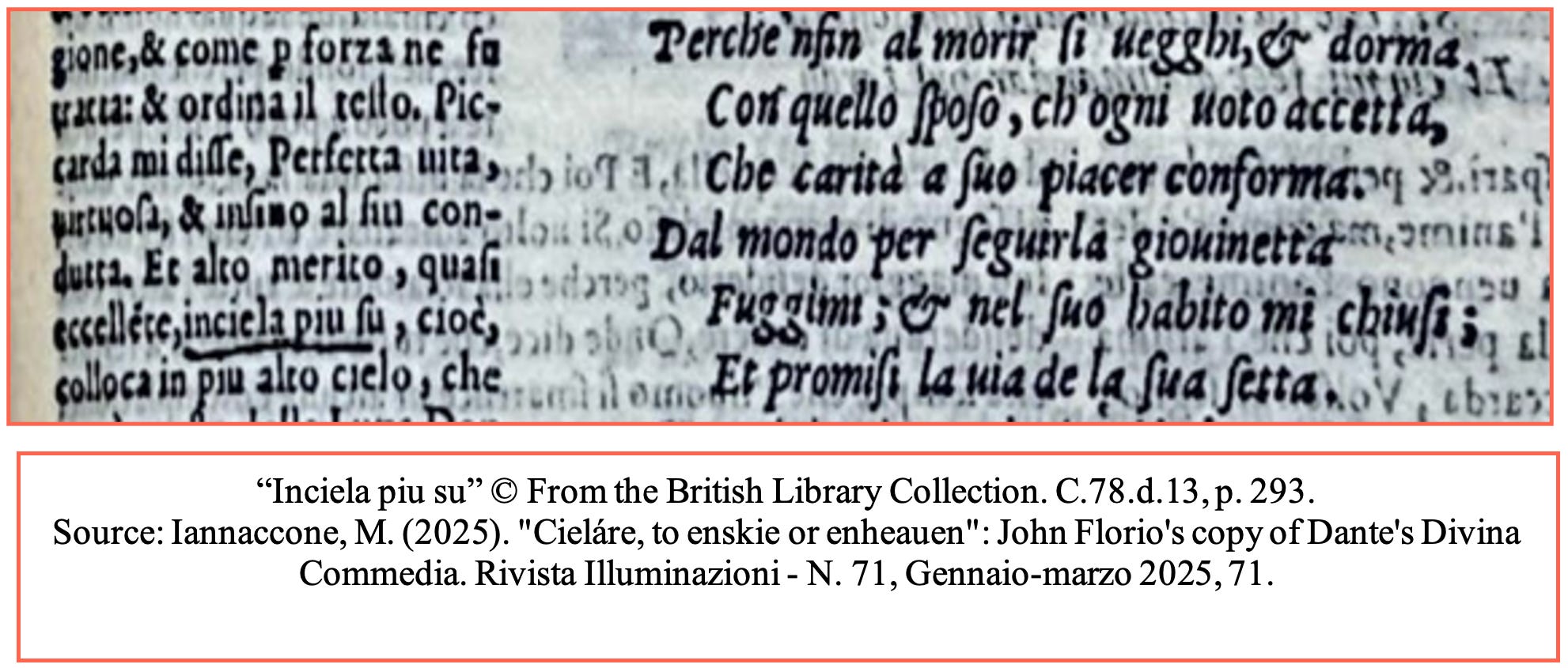
There exists a word that appears only twice in the entire canon of the English language: once in the lexicon of John Florio and once, finally, in the First Folio of 1623. The word is Incielare, which, in the apparent indifference of the possessor of the Paradiso, where annotations are sparse and infrequent, stands out: a stain, an underline that traces a line between two worlds: Dante and Shakespeare.
Florio underlines Inciela in the third Canto and, for the first time, translates it into English in 1598:
Incielare: to advance up or place in heaven, to enter heaven.
However, he creates the neologism enskied only in 1611:
“Ciẻláre, to enskie or enheauen. Also to couer or testerne ouer, to canopie.”
Inciẻláre, to place in, or enter heauen.
It is a term that acts as a linguistic bridge between Italy and England, traversing the fine lines that connect Dante and Shakespeare. That Dante, the most difficult for the Anglo-Saxon world, who seemed almost not to belong to that language, nonetheless succeeded in embedding his influence within the intricate texture of the English lexicon, subtly interlacing with Shakespeare’s world.
In Measure for Measure, published for the first time in the First Folio of 1623, the Dantesque phrase pronounced by Lucio, “I hold you as a thing enskied and sainted” fills the scene, igniting a resonance that transcends mere linguistic coincidence:
Where two literary giants seem separated, their distance dissolves in the stroke of a pen, in the translation that is also transmission, a passage of light between two languages, two worldviews. In that gesture of John Florio, who highlights and translates, a symbolic union is fulfilled between Dante and Shakespeare.
But imagine, for a moment: What if more of John Florio’s books were found? More marginalia in his unmistakable hand? We wouldn’t just be piecing together the working habits of a restless, London-born Renaissance writer, we’d be staring straight at the mechanics of transmission. We’d see, finally, how European ideas made their way into English drama. Not by osmosis. Not by myth. By Florio. Line after line. Word after word.
And then? We’d no longer be talking about influence. We’d be looking at a chain of custody. We’d have evidence, not theory, of how those sources arrived into Shakespeare’s hands.
And that… that would change everything.
So where could the rest of John Florio’s books be hiding? Tucked under the wobbly leg of a desk in a sleepy village library. Stacked in the dusty attic of a country house, long forgotten. Or still at the British Library.
There are things out there still waiting to be found, and that’s part of the thrill. We’re living through a golden age of rediscovery. Digital archives, AI-assisted searches, marginalia studies, spectral ink analysis, all these new tools mean we’re able to see what others couldn’t. And for someone like Florio, a man whose words pulse beneath the surface of the English canon, that means one thing: The trail isn’t cold. Not yet.
Because every rediscovered book, every annotation in the margins, every proverb scribbled in Florio’s hand brings us one step closer to answering a question that has haunted literary history for centuries: How much of Shakespeare… was Florio?
And maybe, just maybe, the next discovery will be the one that turns that question into fact.
Firste Fruites, Formosa, Taikoku Imperial University. [Facsimile eds., New York, Da Capo Press, 1969; Amsterdam, Theatrum Orbis Terrarum, 1969].
Iannaccone, M. (2025). "Cieláre, to enskie or enheauen": John Florio's copy of Dante's Divina Commedia. Rivista Illuminazioni - N. 71, Gennaio-marzo 2025, 71.